
What was the thesis about
The thesis was about a workshop-based intervention designed to help medical students improve their spatial ability. The thesis was a part of my dissertation for my MD in anatomy. This was based on the hypothesis that by sensitizing participants towards visual literacy and providing hands-on tasks that can help improve one’s spatial ability, this will eventually allow for meanigful learning experiences in students.
To test this more specifically, medical students learning anatomy were recruited for the study. There is ample evidence to support the need for spatial training, and some components of the workshop drew inspiration from methodologies in prior studies (1). However, I believe there was a lack of a guiding philosophy in some of these earlier studies, since they targeted specific areas with respect to spatial ability and medical education paradigms.
The basic premise of the thesis was not to provide a targeted learning experience, but to provide a holistic experience that helps develop global abilities that can be applied for life. The workshop was modeled based on prior experiences of the author Dr Daron Mascarenhas in art education, especially teaching anamorphic art and perspective drawing prior to taking up his master’s programme.
Spatial ability for the uninitiated is a cognitive trait that reflects an individual’s ability to interact with spatial problems, like, estimating the depth and volume of an object, estimating the appearance of the object in the mind’s eye if it were cut a certain way, or rotated. All of this mimics a medical trainees experience in learning how to gauge anatomical features, have the psychomotor skills to perform tasks on a human body, and have the visual repertoire to imagine how an organ in the body looks like on radiographs. This skill also extends to specialists in surgical and imaging fields.
What prompted me to work on the project
Personal experience and empirical guesses
Nobody prepares you for being a creative. What started as an ambition to be a medical doctor, soon fragmented into a love and fascination for the arts. Of course, I often ask myself, if serving the sick is more noble than pursuing the creative process. I also realised that nobody prepared me for what it means to be a doctor.
During my time being existential, I had the opportunity to teach perspective drawing to architecture aspirants at DQ Labs, Mangalore. This is an eminent institute that helps aspirants for creative fields like design and architecture, hone their skills. I was thrilled to be a part of educating, and especially teaching art, as it provided a contrast for me to reflect on my own educational experiences in medical school.
For the first time, I experienced studio based learning. I engaged with students by designing and constantly reiterating my methodology as an art educator. I quickly developed my own philosophy in teaching that prompted me to take the next step in being a medical educator.
This brought me towards pursuing an M.D. in Anatomy at St. John’s Medical College, Bengaluru, an institute of national importance. I was thrilled to have the choice of having a non-clinical role and contributing towards the medical field by being a medical educator.
Specializing in anatomy was a choice driven by my artistic drives. I realised this helped me connect deeply with the visual process of learning anatomy. It is here, during my days of being a medical educator and dissecting human cadavers, I was able to reflect on three experiences. One, being a medical student, two, being an art educator, three, being a medical educator in anatomy. These experiences helped me become sensitive towards a vacuum in medical education, and i.e., lack of learning methodologies that sustain and support the spatial nature of anatomy training.
The core defense for this observation is an analogy I like to use based on the ideas proposed in this paper (2) on modality appropriateness. Modality appropriateness means, that a person learning about something learns the most, when the thing being learnt is learnt in a compatible sensory modality.
An example for this is learning music. If one wanted to learn music, regardless of whether there are books on music theory and symbols to codify musical notes, would at the bare minimum require the use of sounds from an instrument so that the changes in pitches, and melodic compositions can be heard and learnt. The sound (modality) is the appropriate method to learn music, and not the books on music theory and music symbols, which are just aids.
Ineffective learning experiences
When I was an art educator, it was obvious that studio sessions where learners engaged with spatial problems was the modal choice. Because a designer or an architect needs a deep understanding of space, and its manipulation to be to applied towards designing.
However, in anatomy education practice, I noticed that this translation was not emphasized in the right way, and several ineffective methods were being used by educators due to misguided philosophies and dogmas on learning. The best testament I can cite for this lack amongst medical educators, is in the manner in which cadaver- based-training in anatomy for medical students is being supplanted or replaced by digital and 3D models. Although these help in some situations, they violate the theory of modal appropriateness.
There is much confusion in the field of anatomy learning and medical training where learning methodologies in my opinion are not designed to sustain and support the modality in which the learning needs to occur. I noticed that students would spend time in activities that were not directly related to improving their spatial aptitude but were boggled with curricular demands that were incongruent with spatial related tasks in anatomy. For example, many students would resort to practices that involved rote learning for instance or focusing on summative assessments instead of developing an understanding of spatial problems.
Imagine if a music student were to mug up, musical notes, instead of learning how to play them, and then was asked to perform on stage. Now imagine further, if medical students mugged up anatomy from textbooks, instead of learning how to interpret human structure, and now were asked to insert a needle into a vein.
Hence the workshop was designed by seeing architecture aspirants learn about spatial problems in the sensory modality that is appropriate, to be able to apply this deeper understanding of spatial problems to their practice. The same way in which a medical practitioner would have to make spatial decisions with regards to clinical examinations, surgical procedures, and learning.
Highlights from the thesis workshops

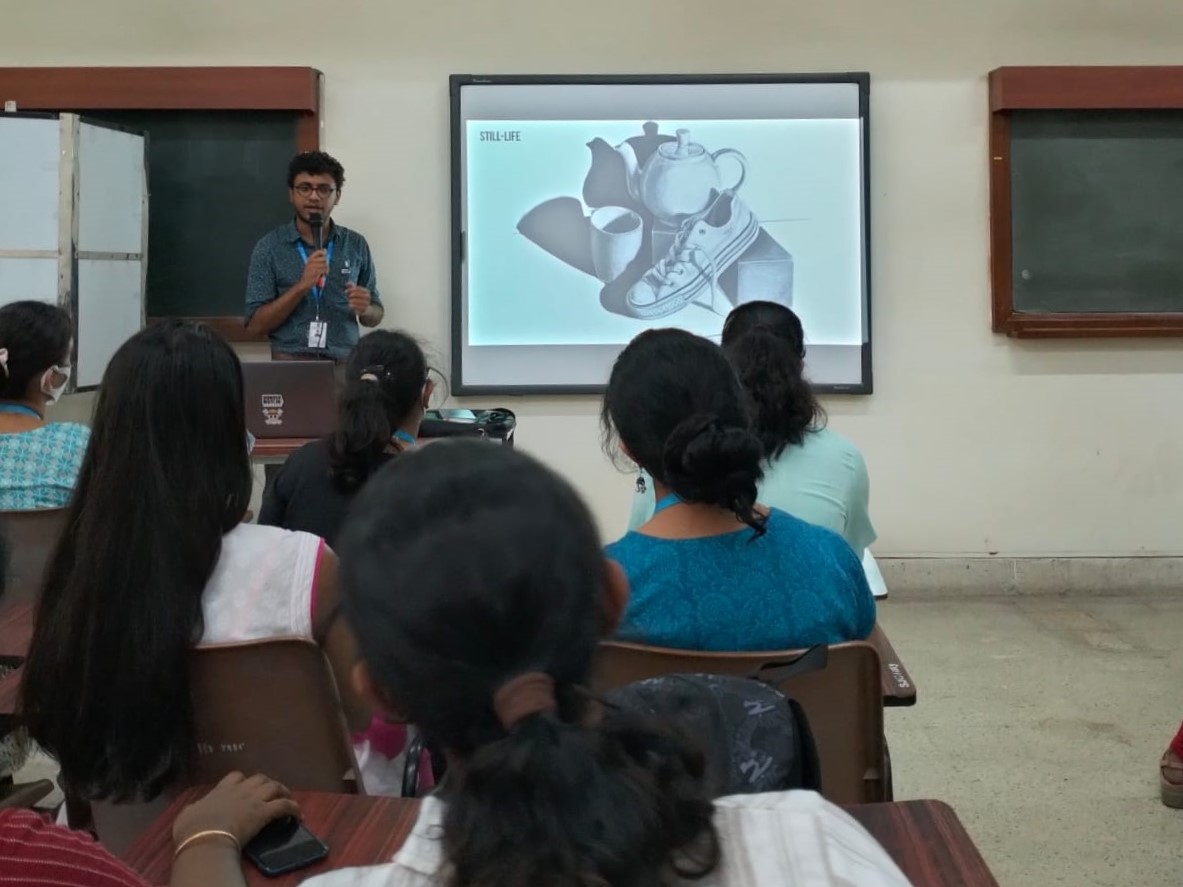
The workshop was modelled around studio-based learning sessions ranging from picking up visual literacy awareness, practicing still-life drawing and modelling, by using human cadaveric material and other medical contexts. The goal was to provide the same experience as an art student learning drawing from life, by honing observation skills.

In the image above, notice how the participants have been trained to measure proportions by closing one eye and using pencils to measure proportions of the various objects. During this session, several participants noticed the nuances of drawing from life, including the tricky phenomenon of foreshortening. Foreshortening is a rather common experience when learners for the first time attempt to draw from life.

The overarching theme of the workshop was to enable learners to develop a global understanding of visual literacy. Visual literacy is the knowledge of interpreting and understanding visual phenomena. For example, a clinician might notice that the blood drawn from a vein by the MBBS trainee, appears bright red, instead of dark red. Such depictions of “bright” and “dark” are what constitutes visual literacy. Some individuals find it difficult to notice these changes and traditional medical curriculums do not have methodologies to emphasize these nuances. Visual literacy training can quickly and effectively help learners pick up awareness about color, texture, form, challenges in observing space, which can then improve the accuracy of clinical observation, which is after all, an observation skill that relies on ones visual faculties.
Conclusion
There is much to be said regarding this area, and I am thrilled to share updates on educational practice that are evidence based. As a visual artist and now a medical educator, I feel deeply about the system, and I feel much work is needed to raise awareness on such matters. I carry my inspiration from my own experiences of being a medical student, where I noticed that my training was inefficient and frustrating. I want students and educators alike to realise these finer aspects in the hope that they find personal fulfillment and answers to frustrating learning experiences.
References
1. Castro-Alonso JC, editor. Visuospatial Processing for Education in Health and Natural Sciences. Springer International Publishing; 2019. Available from: http://link.springer.com/10.1007/978-3-030-20969-8
2. Lodge JM, Hansen L, Cottrell D. Modality preference and learning style theories: rethinking the role of sensory modality in learning. Learning: Research and Practice. 2016 Jan 2;2(1):4–17. Available from: https://www.tandfonline.com/doi/full/10.1080/23735082.2015.1083115
Liked something? leave your thoughts